In Stock
Share your international phone number to discuss pricing and delivery:
Buy this product in 1 click:
Or contact us directly via:


Share your international phone number to discuss pricing and delivery:
Or contact us directly via:
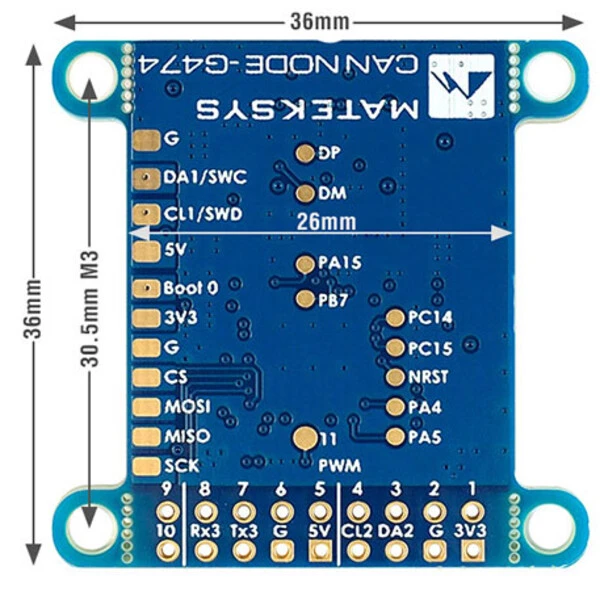
The Matek Systems AP Periph CAN Node (CAN-G474) is a versatile and high-performance DroneCAN peripheral node designed for ArduPilot AP_Periph firmware. It allows multiple sensors and devices — including GNSS, barometers, compasses, PWM outputs, and more — to be connected to the DroneCAN network for simplified wiring and reliable communication. Built around the STM32G474CE microcontroller, the CAN-G474 supports multiple interfaces, making it ideal for UAVs, drones, and robotic systems.
Table 2-1. CAN-G474 Specifications
| Manufacturer | Matek Systems |
| Model | AP Periph CAN Node (CAN-G474) |
| Microcontroller | STM32G474CE, 512 kB Flash memory |
| CAN Interfaces | 2 × CAN bus (5 Mbit/s max, CANFD support) |
| UART Ports | 4 × UART for GNSS, Receivers, Telemetry etc. |
| I²C Buses | 2 × I²C interfaces for sensors (barometer, compass etc.) |
| SPI Interface | 1 × SPI (bottom pads) |
| PWM Outputs | 11 × PWM outputs (DMA / DShot support) |
| Power Supply Voltage | 4.5 V – 5.5 V DC |
| Typical Current Draw | ≈ 62 mA |
| Operating Temperature | –30 °C ~ +85 °C |
| Board Dimensions | 36 mm × 36 mm × 6 mm |
| Mounting Holes | 4 × Ø3 mm (30.5 mm spacing) |
| Weight | ≈ 5.2 g |
Table 3-1. Electrical Parameters
| Parameter | Min | Typ | Max | Unit |
|---|---|---|---|---|
| Input Voltage | 4.5 | 5.0 | 5.5 | V |
| Operating Current | – | 62 | 80 | mA |
| CAN Bus Speed | – | 2.0 | 5.0 | Mbit/s |
| Logic Level Voltage | 3.3 | – | 5.0 | V |
| Operating Temperature Range | –30 | 25 | 85 | °C |
Table 4-1. Physical Parameters
| Board Dimensions (L × W × H) | 36 × 36 × 6 mm |
| Weight | ≈ 5.2 g |
| Mounting Hole Pattern | 30.5 mm square (4 × Ø3 mm holes) |
| Connector Type | GH 1.25 / JST headers for CAN and Power |
NOTE: Ensure secure mounting and maintain proper spacing from power electronics to minimize CAN bus noise and EMI.
Table 6-1. Operating and Storage Environment
| Operating Temperature | –30 °C ~ +85 °C |
| Storage Temperature | –40 °C ~ +90 °C |
| Humidity | 5 % – 95 % (non-condensing) |
There are no reviews for this product.
There are no reviews for this product, be the first to leave your review.
No questions about this product, be the first and ask your question.